#iran-war
23 entries with this tag
The Same Week a U.N.-Backed Panel Found "Reasonable Grounds" to Believe the United States Committed War Crimes in Trump's Iran War — Bombing an Elementary School and a Residential Area and Killing at Least 178 Civilians, Including Women and Children, With Missiles That Scattered Anti-Personnel Tungsten Pellets — Trump Told the Public, Yet Again, That Iran "Wants a Deal" and the War Was "Hopefully" Nearly Over, a Claim Iran Rejected the Same Day
On September 17, 2026, the U.N. Human Rights Council's independent fact-finding mission on Iran — chaired by the Bangladeshi jurist Sara Hossain — reported "reasonable grounds" to believe the United States committed war crimes in two airstrikes in southern Iran on February 28. The strikes killed at least 178 civilians, including women and children. One hit an elementary school in Minab; the other hit a sports complex and residential area in Lamerd with precision-guided missiles that scattered tungsten pellets, an anti-personnel effect designed to kill people rather than destroy structures. The panel's report is not binding, but it adds to the body of international evidence that could one day be used in court — and, notably, the same mission also accused Iran's theocratic government of crimes against humanity against its own people, so this is not a one-sided indictment. On the very day the war-crimes findings landed, Trump was telling the public something else entirely: that Iran "wants a deal" and the nearly seven-month war was "hopefully" nearing its end. Hours later, an Iranian official rejected talks until "Iran's conditions are met," and there have in fact been no negotiations since June. The juxtaposition is the entry. The war Trump launched on a threat the intelligence never found has now produced credible allegations of American war crimes — a bombed school, 178 dead civilians — and his response is to narrate a peace that the other side says isn't happening.
When a Republican Congressman Forced a Vote to Impeach Defense Secretary Hegseth for Unlawfully Waging War on Iran, the Republican Speaker Canceled Congress's Last Scheduled Day and Sent the Whole House Home Early for a Seven-Week Recess — Punting the Vote Past the Midterms to Spare Vulnerable Members From Having to Say, on the Record, Where They Stand on Hegseth
On September 15, 2026, Rep. Thomas Massie, a Republican from Kentucky, introduced articles of impeachment against Defense Secretary Pete Hegseth, accusing him of "high crimes and misdemeanors" for unlawfully waging war against Iran without congressional authorization. Massie filed the resolution as "privileged," a procedural move that would normally force the House to act on it within two legislative days. Speaker Mike Johnson's response was to make sure the House was not there to act: he canceled the chamber's last scheduled votes and sent members home a day early for a seven-week pre-midterm recess, taking a final vote Wednesday night on a Russia sanctions bill and then adjourning. The effect is that the Hegseth impeachment vote will not happen until at least November — after the election. Republican leaders insisted the timing had nothing to do with Hegseth, and Johnson called Massie's effort "ridiculous" while defending the secretary. But the reason was reported plainly: leaders wanted to protect vulnerable Republicans — many uneasy with Hegseth's leadership during the unpopular six-month Iran war — from a politically difficult vote. The tell is that impeachment was never likely to pass a Republican House; what leadership could not stomach was making its own members go on the record about Hegseth at all. So rather than hold the vote and defeat it, they canceled Congress and fled town.
Six Months Into an Unwinnable War With Iran, the Army's Civilian Leader — Secretary Dan Driscoll — Abruptly Resigned After a Months-Long Turf War With Defense Secretary Hegseth, Who Had Already Fired the Army's Top General; His Exit Leaves the Army Without a Senate-Confirmed Civilian or Uniformed Leader in the Middle of the Fight, to Be Replaced, Hegseth Hopes, by a Pentagon Spokesman
On August 31, 2026, Army Secretary Dan Driscoll — the civilian leader of the U.S. Army since February 2025, an Army veteran and close friend of Vice President JD Vance — abruptly submitted his resignation, which Trump accepted, effective September 3. His departure caps months of friction with Defense Secretary Pete Hegseth over the direction of the Army and, above all, Hegseth's purge of its senior officers: in April, Hegseth fired the Army Chief of Staff, Gen. Randy George — with whom Driscoll worked closely — along with other generals, and pushed for tighter personal control over Pentagon messaging and policy. The timing is the alarming part. Driscoll is walking out six months into the war with Iran, a conflict that shows no sign of ending, with American troops deployed and the military stretched thin. Because Gen. George was already fired and now Driscoll is gone, the Army is left without a Senate-confirmed leader — civilian or uniformed — in the middle of a war. Hegseth's reported choice to replace Driscoll is Sean Parnell, the Pentagon's public-affairs chief and a political operative, whose path to Senate confirmation is uncertain. The picture is of a Defense Secretary who has spent his tenure purging commanders and consolidating control over messaging, and who has now driven out the Army's civilian head mid-war — trading experienced leadership for loyalty and communications, at the worst possible moment.
Trump Told Voters to "Pretend, Please, That I'm on the Ballot," Demanding the Midterms Be a Referendum on Him and Staging a $45 Million Convention in His Own Honor — Even as the Vulnerable Republican Candidates Who Have to Actually Win Quietly Scrub His Name From Their Websites, One Swapping "Trump Conservative" for "Proven Conservative," Because Association With Him Has Become the Thing to Hide
Heading into the 2026 midterms, Trump has made himself the center of everything: more than 200 endorsements, near-total control of Republican strategy, an unprecedented $45 million convention built around him, and a direct message to voters — "Pretend, please, that I'm on the ballot." He wants the election to be a referendum on himself. The problem is that his own party's most vulnerable candidates are betting the opposite way. With his approval ratings dismal, his Iran war unpopular, and inflation and record gas prices weighing on voters, a growing number of Republicans in competitive races have quietly begun putting distance between themselves and the president — tweaking websites, softening language, and in some cases openly breaking with him. A Texas congressional candidate who once branded himself a "TRUMP CONSERVATIVE" now calls himself a "PROVEN CONSERVATIVE"; from California to Kentucky to Alaska, campaigns have trimmed the Trump references; in Michigan, a Republican congressman is campaigning on his vote against Trump's Iran war. The majority of GOP candidates still embrace him, and the party dismisses the trend as a "manufactured storyline." But the tell is unmistakable: a president insisting the midterms be about him, while the people who need to win are deciding that the safest thing to do with his name is take it down. He is demanding a referendum on himself that his own candidates are quietly trying to lose the connection to.
Six Months Into the Iran War He Sold as a Weeks-Long "Little Excursion," Trump Declared Victory by Posting an AI Meme of Himself Reading "Mission Accomplished 2026" — Reviving the Most Notorious Premature Victory Boast in Modern American History, the One Bush Staged Aboard the USS Abraham Lincoln — the Very Carrier Now Stranded at Sea Past 260 Days Because This War Won't End; and Around the Same Time, He Approved Sending More Troops
Six months into a war he had promised would be a weeks-long "little excursion," Trump declared he had won it — by posting an AI-generated meme of himself standing between George W. Bush and Iran's slain supreme leader, with one placard reading "Mission Not Accomplished 2001–2021" and another "Mission Accomplished 2026." The imagery deliberately invokes the single most infamous premature victory declaration in modern American history: Bush's 2003 "Mission Accomplished" banner, staged aboard the USS Abraham Lincoln, after which the Iraq war ground on for eight more years. Trump apparently intended the comparison to flatter himself; it does the opposite. The war with Iran is not over. There is no final agreement. The Strait of Hormuz is not reliably reopened. His own defense secretary's "decisive military victory" and his serial victory claims — 58 ships sunk in March, a "deal" in June — have all been overtaken by a conflict that keeps going. And in the clearest tell of all, at roughly the same moment he declared the war won, Trump approved the deployment of more troops to the Middle East. You do not reinforce a war you have finished. The victory lap and the reinforcements cannot both be true, and the reinforcements are the ones with soldiers attached. There is even a grim symmetry Trump seems not to have noticed: the carrier that hosted Bush's false victory in 2003, the USS Abraham Lincoln, is the same ship this archive has documented stranded at sea past 260 days, its sailors rationed to corn dogs, because Trump's war has no end.
"This Is Imperialism": Eight Months After U.S. Special Forces Seized Venezuela's President in a Raid on Caracas, Trump Announced the United States Had Taken "Majority Control" of More Than 65 Billion Barrels of Venezuela's Oil — a Stake Second Only to Saudi Aramco — Struck With the Government That Replaced the Leader America Captured, to Paper Over the Record Gas Prices His Own Iran War Created
On August 28, 2026, Trump announced on Truth Social that the United States had secured "majority control" of more than 65 billion barrels of Venezuela's proven oil reserves — through a new company, structured with private business, in which the U.S. would hold a 55% stake and the right to buy oil at cost, making it the second-largest corporate holder of proven reserves in the world after Saudi Aramco. He offered few details. The context is what gives the announcement its weight: in January 2026, U.S. special forces raided Caracas and seized Venezuela's president, Nicolás Maduro, spiriting him to the United States to face narcoterrorism charges. The oil deal was then negotiated with the government that took his place, led by acting president Delcy Rodríguez. So the sequence is: the United States removed a foreign head of state by military force, and then took majority control of his country's oil from the government installed in his wake — to lower American gas prices driven to record highs by Trump's own war in Iran and the Strait of Hormuz standoff. Michael McFaul, the former U.S. ambassador to Russia, named it in three words on MS NOW: "This is imperialism." Other analysts called it "colonial" and urged Congress to stop it, while critics called it "yet another Trump grift." A superpower seizing a weaker nation's oil after decapitating its government is the oldest story in the imperial book, and the United States just told it out loud.
The War Trump Promised Wouldn't Hurt Americans at the Pump Has Pushed Gas to Roughly $4.10 a Gallon — Up From $2.98 in February, Likely the Most Expensive August on Record — as His Own Strait of Hormuz Standoff Chokes Off the World's Oil Chokepoint, With Ship Traffic Collapsing From Around 130 Vessels a Day to Nearly Zero and His Officials' Promise That the Price Spike Would "Subside" Now Six Months Old
When Trump launched his war on Iran in February 2026 and the resulting standoff shut down the Strait of Hormuz — the waterway through which a fifth of the world's oil passes — his administration assured Americans the price spike would be brief and would soon subside. Six months later it has done the opposite. By late August 2026, the national average for regular gasoline had climbed to roughly $4.10 a gallon, up from $2.98 on February 28, and AAA indicated it was on track to be the most expensive August on record. The cause is not a mystery or a foreign plot: it is the direct consequence of Trump's own war and his refusal to end it. Traffic through the Strait of Hormuz, which normally sees around 130 ships a day, had collapsed to a handful — five vessels one recent Saturday, none registered the following Sunday — while Brent crude pushed near $89 a barrel. Trump's response has been to escalate the rhetoric that keeps the strait closed, threatening to "bomb the shit out of" Oman, the country mediating a reopening. Every dollar added to a gallon of gas is a tax on every American who drives to work, and it traces back to a war launched on a threat the intelligence never found and kept going long after his own generals concluded it could not be won. The president who ran on lowering prices has delivered, through a war of choice, the highest summer gas prices in the country's history.
As the Iran Ceasefire Expired, Trump Threatened to "Bomb the Shit Out Of" Oman — the Neutral Country That Has Quietly Hosted the U.S.-Iran Back-Channel for Years and Is Best Positioned to Broker an End to His Own Faltering War — and Declared the Strait of Hormuz Should Become U.S. Territory
On August 17, 2026, as a 60-day U.S.-Iran ceasefire agreement expired, President Trump threatened — according to Fox News reporter Trey Yingst — to "bomb the shit out of" Oman if it "gets in the way." Oman is not an adversary. It is the discreet, trusted neutral that has hosted the back-channel for U.S.-Iran diplomacy for years — the intermediary both Washington and Tehran rely on precisely because it talks to everyone and threatens no one — and it controls one side of the Strait of Hormuz, the world's most important oil chokepoint. Threatening to bomb the single government best positioned to help end Trump's own faltering, unwinnable Iran war is the opposite of strategy: it is aimed at the peacemaker, not the enemy, at the very moment his own Chairman of the Joint Chiefs has been privately hunting for an off-ramp. Trump paired the threat with a separate declaration that the Strait of Hormuz should become U.S. territory — a casual assertion of annexation over an international waterway split between two other sovereign nations, echoing his musings about seizing Greenland, the Panama Canal, and Canada. It all landed as Iran's army chief announced bounties on American military personnel and the ceasefire lapsed, deepening a war the United States has no military path to win.
Trump Gutted the Joint Military Exercises Defending Ally South Korea — Hours Before They Began — Because Kim Jong Un Is "Unthreatening and Respectful" and "I Understand Him," and to Punish Seoul for Refusing to Join His Iran War, Rewarding the Nuclear Dictator Who Flatters Him at a Democratic Ally's Expense
On August 16, 2026 — hours before they were set to begin — Trump directed Defense Secretary Pete Hegseth to "substantially reduce" the long-scheduled Ulchi Freedom Shield joint military exercises with South Korea, the roughly 18,000-troop drills that keep the mutual-defense alliance ready against a North Korean attack. His reasons: his "very good relationship" with North Korea's Kim Jong Un, and South Korea's refusal to join his war in Iran. The exercises, Trump complained, "send a signal that is totally inappropriate and hostile, to a Country that, as long as Donald J. Trump has been President, has been unthreatening and respectful." He praised a "very wise and reasoned" Kim decision and said, "I understand him. He understands me." Every premise is false or backwards. Kim Jong Un is not "unthreatening": he has declared North Korea is and always will be a nuclear power, keeps testing missiles, and calls South Korea a hostile enemy. The drills are not a provocation; they are the routine readiness of a seventy-year treaty alliance. And cutting them to punish Seoul for declining an unrelated war treats a democratic ally's defense as a chip to be revoked when it won't follow Trump into a conflict it wants no part of. Asian allies were left visibly nervous — watching an American president weaken a treaty commitment because a nuclear dictator was nice to him.
The Iran War Trump Started With No Cause Is Now Fracturing His Own Movement: Tucker Carlson, Once His Loudest Media Booster, Calls the War "Disgusting and Evil," Accuses Trump of Betraying America First, Apologized for "Misleading" His Audience Into Voting for Him, and Has Quit the Republican Party to Build Organized Opposition
One measure of a war of choice gone wrong is when the people who cheered the leader loudest turn on him. Tucker Carlson — among Trump's most prominent media backers through the 2024 campaign, and a defining voice of the "America First" movement — has become one of his sharpest adversaries, and the breaking point is the Iran war. Carlson began criticizing the administration's foreign policy in 2025; after the joint U.S.-Israeli strikes on Iran in February 2026, the split became a rupture. He has called the war "disgusting and evil," accused Trump of putting Israel's interests ahead of America's, and in April 2026 apologized to his audience on his podcast for having "misled" them into voting for Trump. In June 2026 he announced he was leaving the Republican Party over the war, and his theatrical exit has hardened into organized opposition — with talk of a third-party push that could threaten Trump and the GOP. The specifics of Carlson's critique are his own, and some of his framing is inflammatory. But the political fact is the point: the war Trump launched on a threat the intelligence never found — a war his own top general now privately calls unwinnable — has cost him one of his biggest amplifiers and is fracturing the anti-war, "America First" base that put him in office. The coalition is cracking along the exact fault line the war created.
The USS Abraham Lincoln Has Been Stuck at Sea a Record 260+ Days — Its 6,000 Sailors Rationed to Corn Dogs and Tuna-and-Noodles, With Moldy Showers and a Mental-Health Crisis — Because Iran Destroyed the Navy's Main 5th Fleet Supply Base in Bahrain on Day One of the War, a Strategic Defeat Journalist David Rohde Says Hegseth Hid While Calling the Reporting "Completely Misrepresented"
The aircraft carrier USS Abraham Lincoln has been deployed at sea for more than 260 days — the longest modern carrier deployment on record, roughly nine months — supporting Trump's war on Iran. Its crew of about 6,000 has endured food shortages so severe that meals were reportedly reduced for stretches to tuna mixed with noodles or corn dogs, along with moldy showers, broken facilities, and 12-to-16-hour shifts without days off; families and journalists describe a mental-health crisis so acute that some sailors reportedly tried to jump overboard (the Navy denies the latter). The root cause is not bad luck. On the first day of the war, Iranian missiles and drones destroyed much of the U.S. Navy base in Bahrain — the 5th Fleet's decades-old sustainment hub for carrier operations. With Bahrain gone and the waters inside the Strait of Hormuz effectively closed, the Navy fell back on the tiny, remote island of Diego Garcia, which Iran then also struck. The carrier's resupply collapsed. As journalist David Rohde and other reporters have laid out, Defense Secretary Pete Hegseth concealed the strategic significance of losing that base — the fact that Iran had knocked out America's main regional logistics hub — because it is direct evidence the war is going badly. Confronted with the reporting on the Lincoln's conditions, Hegseth called it "completely misrepresented" and attacked the press, as Sen. Chuck Schumer called for his firing and Sen. Ruben Gallego, a combat veteran, demanded an immediate bipartisan investigation.
Trump Is Now in an Open Feud With the Pope — Demanding the First American-Born Pontiff Stop Criticizing His Wars and Deportations, Questioning Whether Leo XIV Was Even Legitimately Elected, and Summoning a Vatican Diplomat to the Pentagon for a "Bitter Lecture" to Get in Line
A diplomatic rift between the United States and the Holy See that began in early 2026 has escalated into an open feud between Trump and Pope Leo XIV — the first U.S.-born pope. Leo has criticized, on moral and humanitarian grounds, the administration's foreign and domestic conduct: the war on Iran, military action toward Venezuela, the Greenland and Cuba crises, the halting of foreign aid, and the mass-deportation operation known as Operation Metro Surge. Trump's response has not been to answer the criticism but to try to silence the critic. He has demanded that Leo refrain from criticizing U.S. policy, and has gone so far as to question the legitimacy of Leo's election as pope. A top Vatican diplomat was summoned to the Pentagon and given what was described as a "bitter lecture" demanding the Pope get behind Trump. The White House invited Leo to celebrate America's 250th birthday in Washington; he declined. Secretary of State Marco Rubio — himself Catholic — was dispatched to meet the pontiff to manage the damage. It is an extraordinary spectacle: the President of the United States pressuring the Vatican to stop making moral objections to his killing and deporting, and impugning the validity of a papal conclave because the man it chose will not bless his policies. A president confident in the morality of his actions does not need to lecture the Pope into silence.
Trump Is Bombing Iran to Stop It From Enriching Uranium — and in the Same Week Signed a Deal Giving Saudi Arabia a Path to Enrich Uranium, Reversing Decades of U.S. Nonproliferation Policy, Handing the Technology to the Crown Prince Who Ordered Khashoggi's Murder, and Then Denying on Truth Social That His Own Signed Deal Allows Any Enrichment at All
On July 22, 2026 — as U.S. forces waged the deadliest stretch of a war against Iran that Trump justifies as preventing Tehran from enriching uranium — the administration signed a landmark civil-nuclear "123 agreement" with Saudi Arabia that opens a path for the kingdom to enrich uranium itself. Energy Secretary Chris Wright and Saudi Energy Minister Prince Abdulaziz bin Salman signed the 30-year deal, under which U.S. companies would help build the Saudi program, including a potential uranium-enrichment facility pending a joint feasibility study. It reverses the longstanding U.S. "gold standard" that required partner nations to forgo enrichment and reprocessing — the exact capability Trump is dropping bombs on Iran to deny it. Critics called the double standard staggering: Sen. Ed Markey said the administration is "allowing Saudi Arabia, a belligerent and authoritarian nation, to develop nuclear weapons technologies while starting a war with Iran under the guise of preventing an Iranian nuclear bomb." Former Sen. Claire McCaskill, reacting on MSNBC, put it plainly: "It's nuts!" Then Trump contradicted his own government: after officials and the agreement text referenced enrichment, he posted on Truth Social, "There will be no enrichment of material!" He also said the deal hinges on Saudi Arabia normalizing relations with Israel. The recipient is the government of Crown Prince Mohammed bin Salman, whom U.S. intelligence concluded ordered the murder of journalist Jamal Khashoggi. The agreement takes effect unless both chambers of Congress pass resolutions to block it within 90 days — meaning it would need a veto-proof supermajority to stop, and almost certainly stands. The message to the world: America's friends may enrich uranium; its enemies get bombed for it — a precedent that guts the nonproliferation regime and hands Iran every reason to seek the bomb.
Trump Handed His Acting AG a Stack of News Articles with "Treason" Written in Sharpie — The DOJ Then Tried to Drag Post and Journal Reporters Before a Grand Jury, and Backed Down
The Washington Post reported on June 23, 2026, that Trump's Justice Department issued grand jury subpoenas this spring to compel reporters from The Washington Post and The Wall Street Journal to testify under oath in a leak investigation — then withdrew them earlier this month after the two newsrooms challenged them in a secret legal fight in the Eastern District of Virginia. The targets were Post national security reporter Ellen Nakashima and three unnamed Wall Street Journal reporters. CNN reported that Trump personally pushed acting Attorney General Todd Blanche to issue the subpoenas, handing him a stack of printed articles with the word "Treason" written across them in Sharpie. The leak hunt was driven by Trump's anger over carefully sourced stories warning of the risks of attacking Iran — stories that turned out to be prescient. Compelling a journalist to reveal sources before a grand jury is extraordinarily rare; the National Press Club called it "one of the most aggressive actions against a free and independent press in recent memory." It followed a deliberate dismantling of press protections: in April, AG Pam Bondi rescinded the Biden-era policy shielding reporters' records, and in January the FBI searched the home of Post reporter Hannah Natanson and seized her devices. No reporter testified — but the DOJ offered no explanation for the withdrawal, leaving open whether the subpoenas will simply be reissued.
The Full Text of Trump's 14-Point Iran Deal: Lift the Blockade, Waive Oil Sanctions, Unfreeze Assets, Pay $300 Billion — and Iran Keeps Its Missiles, Its Proxies, and Its Nuclear Program
A senior U.S. official read the 14-point "Islamabad Memorandum of Understanding" to reporters on a call Wednesday. The full text reveals: the U.S. will immediately lift its naval blockade, waive all Iranian oil sanctions, unfreeze all restricted Iranian assets, commit to ending all sanctions (UN, IAEA, and unilateral), and fund a $300 billion reconstruction plan — in exchange for Iran reiterating it "will never produce nuclear weapons" (a promise it already made under the JCPOA) and reopening the Strait of Hormuz (which was open before the war). Iran's missile program is not mentioned. Its proxy networks are not mentioned. Its enriched uranium stockpile is deferred to a "final agreement." Sen. Murphy: "Make no mistake: these are Iran's terms. They made one single concession — opening the Strait. And it's not even a concession because the Strait was open before the war." The Institute for the Study of War: Iran "emerged from the conflict in a stronger strategic position." Trump withdrew from Obama's JCPOA calling it the "worst deal ever." He then started a war, killed over 1,700 Iranian civilians, and signed a deal that gives Iran more than the JCPOA did — without addressing the missiles he said justified leaving the JCPOA in the first place.
"If We Need to Negotiate with Bombs, We'll Negotiate with Bombs": Hegseth Pledges Strikes on Key Facilities as U.S. Hits Iran for Second Straight Night
Defense Secretary Pete Hegseth, leaving CENTCOM headquarters in Tampa, told reporters: "If we need to negotiate with bombs, we'll negotiate with bombs. And we're very good at it." The U.S. launched strikes on Iran for a second consecutive night — 49 Tomahawk missiles hitting targets as close as 40 miles from Tehran. The strikes destroyed Iran's water reservoirs in Hormozgan Province, leaving 20,000 people without drinking water in 50°C heat. Weapons experts identified fragments as U.S. GBU-39 munitions. Iran retaliated with strikes on U.S. bases in Kuwait, Jordan, and Bahrain. Trump from the Situation Room — with Vance, Kushner, and Witkoff — told Fox News: "If Iran doesn't agree to a deal, we'll bomb the shit out of them tomorrow night." He threatened to target bridges and power plants. CPI hit 4.2% — a three-year high driven by war-fueled energy costs. Brent crude: $94/barrel. The April 8 ceasefire is functionally dead. The war Trump said would last four to five weeks is now at fifteen.
The Pattern: U.S. Has Struck Bridges, Water Reservoirs, a Desalination Plant, a School, Hospitals, and Heritage Sites in Iran — Killing Over 1,700 Civilians Including 254 Children
Fifteen weeks into the Iran war, the pattern of U.S. strikes on civilian infrastructure is undeniable. A precision-guided GBU-39 bomb destroyed drinking water reservoirs, leaving 20,000 without water in 50°C heat. A Tomahawk missile killed 120 schoolchildren at a Minab elementary school — Trump falsely blamed Iran. The B1 bridge in Karaj was cut in half, killing 8 civilians who were picnicking under it during Nowruz. A desalination plant on Qeshm Island was destroyed, cutting water to 30 villages. As of April: 1,701 civilians killed, 254 children, 24 health workers. 763 schools damaged. 334 health facilities damaged, 9 hospitals out of service. Trump threatened to destroy Iran's power plants and said "a whole civilization will die tonight." Amnesty: potentially genocide. Over 100 U.S. legal experts said the strikes "could entail war crimes." The U.S. previously accused Russia of war crimes for doing the same thing to Ukraine's power grid.
"I Don't Think About Americans' Financial Situation. I Don't Think About Anybody."
Asked whether Americans' finances motivate him to make an Iran deal, Trump said: "Not even a little bit. I don't think about Americans' financial situation. I don't think about anybody." He said this as inflation hit a 3-year high of 3.8%, gas reached $4.52/gallon, the war topped $29 billion, and his own party was scrambling to suspend the gas tax before the midterms.
"This Is Just Disarray": Pentagon Insiders Sound Alarm as Hegseth Purges Officers With Impeccable Records
Insiders describe the Pentagon as in "disarray" and "an atmosphere of anxiety and mistrust" as Defense Secretary Hegseth has fired or sidelined dozens of senior officers — the Chairman of the Joint Chiefs, the Army Chief of Staff, the Navy Secretary, the Chief of Naval Operations, the Cyber Command chief, the NATO military rep, and more. All during an active war. A current official: "He's just really uncomfortable with anyone who could potentially be outshining him."
Trump Pulls 5,000 Troops From Germany Because Merz Criticized His Iran War — Threatens "A Lot Further"
Trump ordered 5,000 troops withdrawn from Germany after Chancellor Merz said the U.S. was being "humiliated" by Iran and lacked a strategy. Trump then threatened to go "a lot further" than 5,000. Spain and Italy may be next. He is dismantling NATO's core European deterrent because an ally criticized a war that NATO refused to join.
Trump Attacks Pope Leo XIV: "If I Wasn't in the White House, Leo Wouldn't Be in the Vatican"
Trump went after the first American pope on Truth Social, claiming credit for his papacy and demanding he "stop catering to the Radical Left." It is the first time in U.S. history a sitting president has been in open conflict with an American pope. Pope Leo had called Trump's "civilization will die tonight" threat "truly unacceptable."
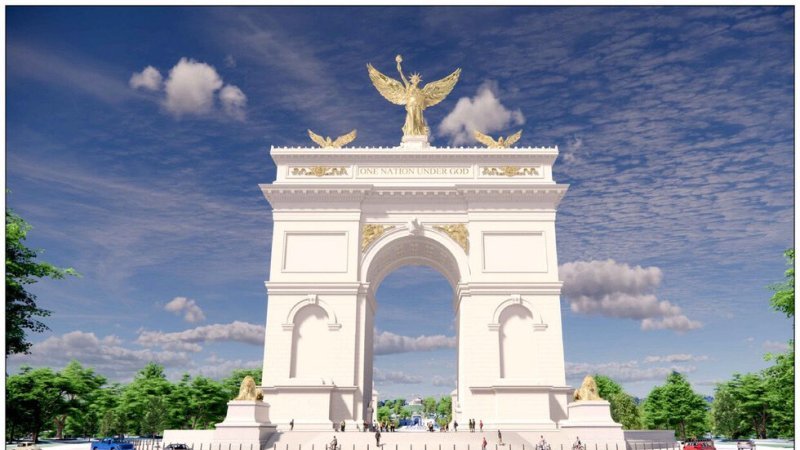
Trump Files Plans for 250-Foot "Triumphal Arch" — A Monument to a War He Lost
Trump announced his administration officially filed plans for "the GREATEST and MOST BEAUTIFUL Triumphal Arch, anywhere in the World" — a 250-foot gold-accented monument between Arlington Cemetery and the Lincoln Memorial. Historically, triumphal arches honor military victories. Trump has none.
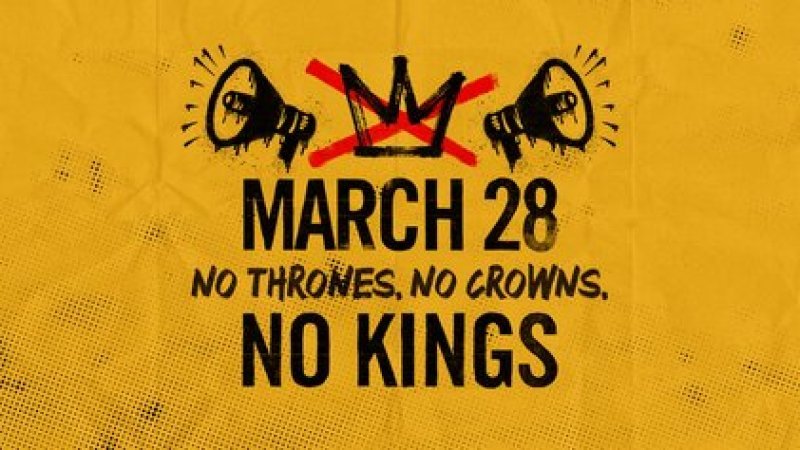
"No Kings" III: Largest Single-Day Protest in U.S. History — 8-9 Million Across 3,300+ Cities
The third "No Kings" protest is believed to be the largest single-day protest in U.S. history: 8-9 million people across 3,300+ events in all 50 states. Springsteen headlined. Nearly half the events were in GOP strongholds. The White House dismissed it as "leftist funding."